Georgina Hammond
Animator
Utopia/Dystopia City Visions
This project was done in two parts, the first was to be completed in the first term of the year and was a cross-disciplinary collaboration with Architects, where we worked together to design, create and build a kanoe club house and its surrounding area. we then filmed this location and edited it to show what the building could look, sound and feel if it was to be built in real life.
The second part was following the cross-disciplinary collaboration with Architecture and undertaken in term 2, we were tasked to develop our own individual city-scape sequence. By creating a bricolage set and montage sequence that visually tells a story about the function and identity of a place – depicting either a utopian or dystopian representation of it. All of my works for this project are as follows - from start to finish.
Hayes - cross-disciplinary brief with the Architects
The first brief of the year was a cross-disciplinary brief with the Architects. The aim was for the architects to build a canoe club house which was a live project for them as it had the potential to actually be built. Us animators than teamed up with them to help them build a city vision set out of bricolage materials and then test the sets under different lighting conditions and projection mapping some visual footage onto the buildings. We also filmed all of this in a different range of shots and angles and then edited with sound and music, with the results being shown in a gallery.
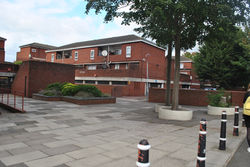
To get this brief started we took a trip to Shackles Dock in Hayes which is where the canoe club was to be built. We spent a couple of hours investigating the area, taking photos, videos and recording sound to get a strong idea of what the area was like. We then took the collected audio and visual footage and created a montage sequence telling a story of Shackles Dock to have more of an awareness of the area.
From there we worked fast with found and recycled materials to build our sets quickly but effectively so that we had plenty of time to practise lighting and projecting images so that we could collect a range of footage to come up with the best final edit as possible.
Working with the Architects was a pleasure to do as it allowed me to see how someone from a more strict environment works, architects work very accurately and like to have everything to scale which made me work more precisely and try to fit everything at an accurate size but this also meant that they were less open to having items strewn about on the set and it took them to actually see video footage before they believed that objects can look very different when filmed (depending on how it is lit and the camera angle) than it does in real life.
Overall, I think this was a great project to work on, everything was fast pace, animators and architects worked well together from the start, each side learning something new from the other and allowing us to branch our contacts into new areas and gain our animations some more recognition.
 |  |  |
|---|---|---|
 |  |  |
 |  |  |
 |  |  |
 |  |  |
 |  |  |
 |  |  |
 |  |  |
 |
 Mundon Oaks Sunrise 2 |
|---|
 Mundon Oaks Sunrise 1 |
 Mundon Oaks Sunset 1 |
 Mundon Oaks Sunset 3 |
 Mundon Oaks Sunny Day 2 |
 Mundon Oaks Sunny Day 1 |
 Mundon Oaks Night 7 |
 Mundon Oaks Night 5 |
 Mundon Oaks Night 6 |
 Mundon Oaks Night 4 |
 Mundon Oaks Night 1 |
 Mundon Oaks HDR |
 Mundon Oaks Night 3 |
 Mundon Oaks Night 2 |
 Mundon Oaks Cloudy 4 |
 Mundon Oaks Cloudy 2 |
 Mundon Oaks Cloudy 3 |
 Mundon Oaks Cloudy 1 |
The Petrified Oak Forest of Mundon
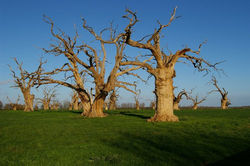
Throughout Essex there are many small, often unnoticed villages and quietly tucked away is the beautiful village of Mundon which would have very few visitors if it wasn’t home to the Petrified Oak Forest of Mundon.
Essex is a very diverse county with large urban areas whose boundaries blur with London; vast coastal seaside towns that offer the perfect tourist experience; and small rural villages where there is farmland as far as the eye can see and roads become too narrow. Mundon is the latter Essex experience, surrounded in winding country roads with fields and trees either side of you.
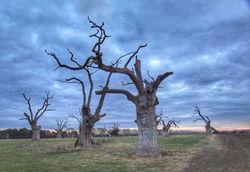
The Petrified Oak Forest can be difficult to find unless you know where to go and at first sight, the dark and twisted branches of the once magnificent oak trees can seem haunting. The field is very quiet, the grazing sheep and alpacas bringing life to a place that would otherwise seem dead.
The oak trees are tall, strong and stand against a backdrop of greenery which leaves you wondering what could have happened to such a mighty forest. The oak forest goes back as far as the Doomsday book, where it was said that the land was filled with water, as time went on the water slowly drained away and with it, it has drained away the life of these oak trees, leaving frozen in time. A less convincing story behind the Petrified Oak Forest of Mundon is stories of Witches being common in the village and that Witches were involved with their demise.
Tree Making
After deciding on what I was going to do for the second term Utopia/Dystopia project, the next step was making the trees and city scape. Initially I decided to make the trees out of insulation foam as this was easy to cut and shape, however, it wasn’t as easy as I first thought, the branches kept breaking so in the end I made them separate from the tree body and stuck them in using match sticks, the end result looked awful! It wasn’t even close to what I had in mind so off I went to search the internet for some ideas on how to make trees! I came across the video on the top right, which is a model tree making tutorial for train sets, it was exactly what I was looking for! I then took this idea and instead of making the trees out of just wire (too small for what I want and very little trunk) I found some wooden cylinder toy bricks, whittled them down a little bit and thinned one end and glued the wire trees to the thinned end so it made it a larger tree with a thicker trunk. I think coated the whole tree in melted glue so that it was pliable but strong enough to stay in shape, painted the whole lot white so I can project on it and hey-presto!
I also made a city skyline out of foam board which I will be placing behind an infinity sheet and lighting from behind so that when filming I will have a silhouette of a city scape in the background – unfortunately I didn’t film the making of this but it was a simple outline that I cut straight out of the foam board and glued on top of another piece of foam board so that it was free standing.
I really like this technique of making models out of wire, it’s something I’ve not thought of using before but it’s really effective, it’s definitely a material I will consider using more in the future and practising with as it seems it can be moulded in to just about anything. There are so many tutorials online on how to make different models so that can also come in handy in the future.
Utopia/Dystopia – Hans Op De Beeck
Hans Op de Beeck is a Belgian visual artist who has developed his career through international exhibitions over the past ten years. His work consists of sculptures, installations, video work, photography, animated films, drawings, paintings and writing.
Hans Op De Beeck is one of the key influences on my Utopia/Dystopia project with his video Staging Silence 2 (top left). The opening sequence of this video is Hans placing trees in various positions on the set, adding smoke to the scene to make it feel misty/foggy and then dimming the light to feel as if night has come while also playing music relative to night time in a forest. Watching this really had some creativity flowing with me, it fitted so well with the ideas I had in my head and gave me a better understanding of how I wanted to present my ideas. I would like to use similar lighting techniques within my work to make the scenes feel more realistic. I also like how Hans films himself building the scenes so you can see his processes and what bricolage materials he has used to create realistic settings, this is also something I would like to do with my project with my ideas being; filming placing the trees and then placing bricolage materials to create a city scape in the distance from the trees.
Id really like to learn more of Hans techniques in the future and inherit his ability to take everyday materials and turn them in to realistic sets so I’ll definitely be practising more.
Projection Mapping
Clement Briend
Clément Briend is a French photography who uses projection as a photographic exploration of his surroundings. To the right is one of his videos covering his gargoyle projections, his work blurs the divide between reality and imagination as large-scale faces or masks that emerge from trees. His work is something that really fascinates me, the way the faces match perfectly with the trees and even look realistic. Something like his work fitted so well with some of the ideas I have for this project and every time I watch one of his gargoyle videos Im sat with a mind full of ideas that I want to try, seeing his work just gets my brain flowing and I find it so inspiring. It reminds me that it is possible to project just about anything on to everything and that leaves me wanting to test so much on my model trees.
Ice Book
The Icebook is the world's first projection mapped pop-up book, designed and made by Dave and Kristin McGuire. By day, each of the 11 pages is no more than a few feet tall featuring intricately hand-cut blank pop-ups, but when the lights go out and a projection is beamed onto the book's pages, the paper comes to life as if by magic and a dark, atmospheric story unfolds about a man on a journey through the wilderness. I absolutely love this book, I never tire of watching videos about it and this is a style I would really like to try out in the future. It gives me ideas of having a character/shadow walking around my trees, as if lost in the woods. However, beyond my trees project, this leaves me wanting to build and entire set I can project on and tell a story with. Its an idea I would like to use for my 3rd year, or even as a summer project. Its possibly one of the most beautiful videos and works of art I have seen.
Find out more about the ice book here; http://www.theicebook.com/The_Icebook.html
Tchalkovsky an Elegy
The video to the right was written, directed and animated by Barry JC Purves. He created it as an interpretation of the life of composer, Pyotr Ilyich Tchaikovsky. What I like most about this video is that they’re not too precious with the projecting, it’s clear that they’re trying to project on to the backgrounds but on some occasions the projection goes over the model and items in the front of the scene, to me this is something better than being neat and making sure it only goes on the background, for me it pulls everything in the scene together and makes it all as one. It also means the viewer is concentrating on the whole scene instead of watching just the projection and miss what the character is doing. This video has made me realise that in future, I don’t need to edit the projection to make sure it goes into just one specific place but I can in fact just let the projection fall where it wants.
Find out more here; http://www.barrypurves.com/Tchaikovsky
Utopia/Dystopia-City Visions - Conclusion
The second part of this project is one I was able to get stuck in to really fast; straight away I knew what I wanted to do, I had ideas on how I wanted to do it and I had loads of ideas for finished videos. I flew straight in to building the models and had my first test videos done a week after we were given the task. The biggest problem with this project? I had so many ideas I didn’t know where to start, I was sat there asking myself; how many can I get done? Which ones would look best? So I decided to just work as fast as I could and get as many of my ideas done and then decide which were best at the end. However, something I’ve had a struggle with all year is time management, so before I knew it, although I had lots of test videos, I didn’t have enough time to get the videos I really wanted to do, done. Now this project is over, I think it would have been more productive to have 1 very good video at the end instead of lots of okay videos. In hindsight, I should have spent my time focusing on one video, spending my time to create some really great projections such as the man walking through the woods as the city is being built in the background or project a lake around the trees and the water going down as a city is built but because I spent time making lots of smaller videos I never had the time to try these two ideas. I also need to spend some time over the summer to teach myself some more tricks and techniques to projection mapping, it’s something I’m really interested in doing and I know how to do the basics using videos but I want to be able to make my own videos to project and I would like to use small pieces of projection throughout my future works.
Below is what I feel is my best video out of all of the tests I done, this is a top motion video, using the torch on my phone to slowly move it over the set, at the back of the set is a wall and behind that is a foamboard cut out of a city. As I moved the light from the front of the set, up and over to the back, the light and shadows made it look as if a city was growing and the trees ended up being so dark it was as if the city had blocked them out. This is what I was going for and is how I wanted my idea to come across but I think it could have looked a lot better; the white background behind the trees needed to be bigger so that the black at the sides couldn’t be scene, I could have used a better light so that everything was a bit clearer and easier to see and I could have mounted the light better so that is isn’t so shaky throughout the video. However, overall I’m happy with this video and I really enjoyed this project.
Micro-Macro
This project was also a cross-disciplinary collaboration with jewellery-silversmith. We explored how to deconstruct and reconstruct decorative forms as abstract sequences using stop motion and projection mapping, as well as experimenting with how scale affects our design. The purpose is to investigate and rethink the jewellery design process through animation, looking at how the liminal stages in the design process can be frozen in time, or accelerated and resized to reveal new forms and outcomes for our work. We also explored the development of sound tracks. We done this by recording the sounds during the making process – embellishing them, as well as juxtaposing and substituting them with other sounds to create a more immersive experience and/or promotional audio-visual material for use at shows and on the internet.
Playing with materials
This part of the project was brilliant, Jemma and I didn’t stop laughing the whole time. We had so much fun taking things apart, cutting items up, stretching the metals and looking at the different sounds items made.
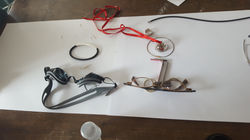
Taking the phone apart was so hard! We were hitting it as hard as possible with the hammer and it just wouldn’t break! It just goes to show how good old phones were made as if we tried this with a modern phone it would have been in pieces in no time. We were trying to pull it apart with plyers, doing everything we could to break it apart and after two hours, we had to give up and work with what we had, we did mange to get a lot off of the phone though, its hard to think that so much goes in to making something so small. It really opened our eyes to look at materials more closely, to listen to them more and have a wider imagination and notice that you can use so much junk to make just about anything.
Although we have lots of other items we can use, after playing with everything and talking it through we decided the phone and its pieces are the best things to use moving forward as it has so many small components we can make anything out of and it made so many sounds, it just leaves us with a wide range of possibilities
 |
|---|
 |
 |
 |
 |
 |
 |
 |
 |
 |
 |
 |
 |
 |
 |
 |
 |
 |
 |
 |
 |
 |
 |
 |
 |
 |
 |
 |
 |
 |
 |
 |
 |
 |
 |
Cornelia Ann Parker
Cornelia Ann Parker OBE, is an English sculptor and installation artist. Parker is best known for large-scale installations such as Cold Dark Matter: An Exploded View (video below) which she had a garden shed blown up by the British Army and suspended the fragments as if suspending the explosion process in time. In the centre was a light which cast the shadows of the wood dramatically on the walls of the room. Seeing this work is what gave us some inspiration with our work, we knew we wanted something suspended and after playing with material we knew it would be the phone in pieces that we would suspend. Then we saw Parker’s work and it fitted so perfectly with our ideas, so we looked into more of her work and even how audiences reacted to seeing her work. We then kept these in mind when setting up our work and looking at ways we can light the pieces to get the best shadows.
Testing our work
Once we had our pieces made it was time to get in to action, we had some many ideas so we knew we needed to work fast to get as many of our ideas made. We knew our main idea would be suspending the phone some way so we decided to leave that one till last as we knew exactly how we wanted to do it and knew that it wouldn’t take long.
We then spoke about what we wanted to experiment with and projection came up straight away, it was something we both wanted to play around with so we set about finding some videos on the internet and using them to project onto our work, we tried so many different things and we were left with so many test videos we had to choose the ones to keep and the ones to delete, this was another part of the project we had a lot of fun with, getting certain parts of jewellery to light up or having the projection light making the jewellery sparkle in different ways was leaving us so surprised as it was results we just weren’t expecting.
I was also able to get some brilliant photography’s of our work, the metals shone up so well under light and with so many different textures to the objects and a never ending way to set the objects up we were able to make the objects look like something new and completely different to how they looked in the videos.
 |
|---|
 |
 |
 |
 |
 |
 |
 |
 |
 |
 |
 |
 |
 |
 |
 |
 |
 |
Micro-Macro - Conclusion
I had so much fun with this project! We could literally come up with anything, there was so much scope for work, so much we could do and who doesn’t enjoy destroying stuff! I think this was one of the best projects from the year, I got on really well with Jemma who I was teamed up with and we have plans to work together in the future.
Playing with the materials was great, taking things apart, cutting it up, stretching the metal etc was really eye opening, just to see how many small components make up something such as a phone. Discovering the sounds things made was really cool too, you never truly listen to the sounds but once we had sat and really listened and recording the sounds, it’s amazing what you can use to make the sounds of walking (phone opening and closing) or rain (shaking some beads)
We made so many different objects and recorded in so many different ways, we tested everything we could imagine and had so much fun doing so, out of everything we recorded I think the bottom left video is the best one we made, I love watching the components fall down, seeing every item that is used to make a phone, but not only that, depending on how you look at it, it doesn’t even look like a phone, if you use your imagination, it can look like so much, like a space ship descending or a futuristic elevator, I really like the shadows the lights produce too. I think overall it is a generally good video.
To the bottom right is a video I done with Jemma, alongside this project. It is a face mask made out of plastic which we have then used stop motion to make it appear as if the mask is moving and opening out, although it’s a fast video you can really see the movement in the mast and its different shapes and textures.