Georgina Hammond
Animator
 |
|---|
 |
 |
 |
 |
 |
 |
DADA
Dada was an art movement formed during the First World War in Zurich in negative reaction to the horrors and folly of the war. The art, poetry and performance produced by dada artists is often satirical and nonsensical in nature.
Using materials that I found and recycled I made a dada inspired puppet. Using twisted and bent wire for the main form of the body and then odd material to cover. I really enjoyed this task, taking junk and making whatever sprung to mind. I was really pleased with the final outcome of my puppet and feel it was definitely dadaesque, it could stand! Which is a lot harder to do than you think. It would have been a better puppet if the legs were a little longer but that wasn’t too bad.
What was really hard though, was getting it to walk in the set without falling. Where the floor in the set was uneven and with one leg up the puppet was heavier on one side so it kept toppling over. It rectify this, i cut some of the wire on the feet so there was metal points on the bottom of each one, I then used these points to push into the bottom of the set so it was stuck into the cardboard, ergo – no falling! But it is pretty hard getting the feet into the cardboard while having the puppet stay in the same position for the walk.
The video is also a little jumpy because of the rookie mistake of not having a tripod for the camera!
Walk Cycle
It may have taken me a few attempts to get the walk cycle correct but I learnt a good few lessons along the way and once it clicked it was pretty simple and quick to draw the walk cycle in the video.First off, trying to be smart and draw a small, simple character is far from ‘simple’, it isn’t that easy at all, a small character toddling along the page is all well and good but when it came to the squash and stretch element, it looked a mess. Making that mistake was the first ‘life of animation’ lesson that I learned.
Notes to self
Feet: heel-toe action
Legs: stride, two key frames, leg overlap
Body & Head: bobbing motion of head neck and torso, and head tilting side to side
Rock & Roll: action of hips & shoulders – legs do not come from a single point, arms do not grow out of neck.
 |
|---|
 |
 |
 |
 |
 |
 |
 |
 |
Location Drawings -Quentin Blake
Sir Quentin Saxby Blake, CBE, FCSD, FRSL, RDI is an English cartoonist, illustrator and children's writer. He may be known best for illustrating books written by Roald Dahl.
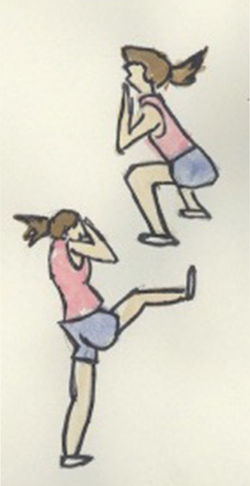
Blake was my main inspiration during mark making and location drawings. I like his shaky hand drawn approach and bright, bold water colours along with the simplistic details.
Below are some of my favourite of his pieces compared to my own which I have based on his techniques.
I haven’t done much water colour painting before so it took a few attempts before I eventually got the hang of it. After finishing these photos I’ve decided that I definitely need to buy some better brushes so that they hold the water better, that way I can get a more watery effect. I am pleased with the way my paintings have come out but i would have liked them to have a more watery effect. I also need to work on my outlining technique. For these painting I just used a Sharpe to outline them but I think in future I’d like to try outlining with a fountain pen as that is inky it dries with a watery effect. Also instead of a solid outline I’ll do more broken outlines, similar to how Blake does his
BOOK LIST
Cracking Animation
The Animation Bible
Animators survival Kit
Andy Warhol - Klaus Honnef
The 1960's home - Paul Evans
Pop Art Design
Furniture and Interiors of the 1960's
Frame by Frame Stop Motion
 |  |
|---|---|
 |  |
 |  |
 |